
Reproductive phenology and germination of Guapira hirsuta (Choisy) Lundell
DOI:
https://doi.org/10.4336/2026.pfb.46e202502342Keywords:
Nyctaginaceae, Recalcitrant seeds, Desiccation toleranceAbstract
The objective of this study was to characterize the reproductive phenology, classify seeds desiccation tolerance, and model the germination curve of the Guapira hirsuta. For the phenological study, 17 individuals were monitored monthly from October 2021 to September 2022 for the presence or absence of flowers and fruits. Desiccation tolerance was assessed using seeds from eight individuals of G. hirsuta, collected in August 2021 in the Lago da Pedra do Cavalo Environmental Protection Area (Bahia, Brazil). Four treatments (15%, 12.5%, 10%, and 5% moisture content) were tested, with four replicates of 25 seeds each. Germination tests were conducted in a germination chamber. Logistic and Gompertz models were tested to fit the germination curve of the fresh seeds. G. hirsuta flowering occurred in June, with fruiting from July to September. The timing of seed dispersal at the study site coincided with the period of low water availability. G. hirsuta seeds are recalcitrant and exhibit slow germination, requiring 150-days for germination to stabilize and 92-days to reach 50% germination.

Downloads
References
Amorim, I. L. et al. Fenologia de espécies lenhosas da caatinga do Seridó, RN. Revista Árvore, v. 33, n. 3, p. 491-499, 2009.
Berjak, P. & Pammenter, N. W. From Avicennia to Zizania: seed recalcitrance in perspective. Annals of Botany, v. 101, n. 2, p. 213-228, 2008.
Bewley, J. D. et al. Seeds: physiology of development. germination. In: Bewley, J. D. et al. (ed). Physiology of development, germination and dormancy. 3rd ed. New York: Springer Science, 2013. p. 133-181.
Camargos, V. L. et al. Influência de fatores edáficos sobre variações florísticas na Floresta Estacional Semidecídua no entorno da Lagoa Carioca, Parque Estadual do Rio Doce, MG, Brasil. Acta Botanica Brasilica, v. 22, n. 1, p. 75-84, 2008.
Costa, R. T. et al. Flora arbórea de capões na Reserva da Biosfera da Serra do Espinhaço. Revista Espinhaço, v. 10, n. 1, p. 1-14, 2021.
Estevan et al. Estrutura e relações florísticas de um fragmento de floresta estacional semidecidual, Londrina, Paraná, Brasil. Ciência Florestal, v. 26, n. 3, p. 713-725, 2016.
Finch-Savage, W. E. Seed development-onset of desiccation tolerance. In: Thomas, B. et al. (ed.). Encyclopedia of applied plant science. Oxford: Academic Press, 2003. p. 1229-1285.
Fournier, L. A. Un método cuantitativo para la medición de características fenológicas en árbores. Turrialba, v. 24, n. 4, p. 422-423, 1974.
Fox, J. et al. Companion to applied regression: version 3.1-5. 2023. (Package "Car"). Available from: https://cran.r-project.org/web/packages/car/car.pdf. Access on: Jul 18th, 2023.
Furlan, A. & Giulietti, A. M. A tribo Pisonieae Meisner (Nyctaginaceae) no Brasil. 2014. Boletim de Botânica, v. 32, n. 2, p. 145-268, 2014.
Hong, T. D. & Ellis, R. H. A protocol to determine seed storage behaviour. Rome: International Plant Genetic Resources Institute, 1996. 62 p. (Techical bulletin).
Hothorn, T. et al. Testing linear regression models: version 0.9-40. 2022. (Package “Imtest”). Available form: https://cran.r-project.org/web/packages/lmtest/lmtest.pdf. Access on: Jul 18th, 2023.
Lacerda, D. M. A. et al. Reproductive phenology differs between evergreen and deciduous species in a Northeast Brazilian Savana. Acta Botânica Brasílica, v. 32, n. 3, p. 367-375, 2018.
Lund, U. et al. Circular statistics: version 05-2. 2022. (Package ‘Circular”. Available form: https://cran.r-project.org/web/packages/circular/circular.pdf. Access on: Jul 18th, 2023.
Luna-Nieves, A. L. et al. Interplay of environmental cues and wood density in the vegetative and reproductive phenology of seasonally dry tropical forest trees. Biotropica, v. 54, n. 2, p. 500-514, 2022.
Marcos-Filho, J. Fisiologia de sementes de plantas cultivadas. 2 ed. Londrina: ABRATES, 2015.
Menino, G. C. O. et al. Inselberg como fonte de diversidade β em uma matriz vegetacional, no município de Coqueiral-MG. Ciência Florestal, v. 5, n. 4, p. 947-958, 2015.
Morellato, L. P. C. et al. Applications of circular statistics in plant phenology: a case studies approach. In: Keatley, M. & Hudson, I. L. (ed.). Phenological research: methods for environmental and climate change analysis. New York: Springer, 2010. p. 357-371.
Morellato, L. P. C. et al. Linking plant phenology to conservation biology. Biological Conservation, v.195, p.60-72, 2016.
Neves, S. P. S. et al. The roles of rainfall, soil properties, and species traits in flowering phenology along a savanna-seasonally dry tropical forest gradient. Brazilian Journal of Botany, v. 40, p. 665-679, 2017.
Nogueira, F. C. B. et al. Fenologia de Dalbergia cearensis Ducke (Fabaceae) em um fragmento de floresta estacional, no semiárido do Nordeste, Brasil. Revista Árvore, v. 37, n. 4, p. 657-667, 2013.
Oliveira-Neto, N. E. et al. Biodiversity inventory of trees in a neotropical secondary forest after abandonment of shaded coffee plantation. Forest Biogeosciences and Florestry, v. 10, n. 1, p. 303-307, 2017.
Oyerinde, R. O. et al. Desiccation and chilling sensitivity of the recalcitrant seeds of Trichilia dregeana harvested from two provenances. South African Journal of Botany, v. 156, p. 376-384, 2023.
Peixoto, G. L. et al. Estrutura do componente arbóreo de um trecho de Floresta Atlântica na Área de Proteção Ambiental da Serra da Capoeira Grande, Rio de Janeiro, RJ, Brasil. Acta Botanica Brasilica, v. 19, n. 3, p. 539-547, 2005.
Pinheiro, J. et al. Linear and nonlinear mixed effects models: version 3.1-168. 2023 (Package “nlme”). Available from: https://cran.r-project.org/web/packages/nlme/nlme.pdf. Access on: Jul 18th, 2023.
R Core Team. R: A language and environment for statistical computing. 2022. R Foundation for Statistical Computing. Austria, 2022. Available from: https://www.R-project.org/. Access on: Jul 18th, 2023.
REGRAS para Análise de Sementes. Brasília, DF: Ministério da Agricultura, Pecuária e Abastecimento, Secretaria de Defesa Agropecuária, 2009. Available from: https://www.gov.br/agricultura/pt-br/assuntos/lfda/arquivos-publicacoes-laboratorio/regras-para-analise-de-sementes.pdf/view. Access on: Jul 18th, 2023.
Rocha-Santos, L. et al. The loss of functional diversity: a detrimental influence of landscape-scale deforestation on tree reproductive traits. Journal of Ecology, v. 108, n. 1, p. 212-223, 2020.
Rochelle, A. L. C. et al. Florística e estrutura de um trecho de Floresta Ombrófila Densa Atlântica Submontana no Parque Estadual da Serra do Mar, em Ubatuba/SP, Brasil. Biota Neotropica, v. 11, n. 2, p. 337-346, 2011.
Rossetto, E. F. S. et al. Guapira hirsuta (Choisy) Lundell. In: REFLORA: flora e funga do Brasil. Rio de Janeiro: Instituto de Pesquisas Jardim Botânico do Rio de Janeiro, 2023. Available form: https://floradobrasil.jbrj.gov.br/FB10910.Access on: Jul 18th, 2023.
Salvador, H. F. et al. The dynamics of Mauritia flexuosa (Arecaceae) recalcitrant seed banks reveal control of their persistence in marsh environments. Forest Ecology and Management, v. 511, p. 120-155, 2022.
Santos, C. C. O. et al. Fenologia e germinação de sementes de sobraji. Revista Craibeiras de Agroecologia, v. 5, n. 1, e9443, 2020.
Santos, R. A. et al. Balanço hídrico e classificação climática de Köppen e Thorthwaite no município de Feira de Santana (BA). Geo UERJ, v. 33, e34159, p. 1-17, 2018.
Silva, B. A. et al. Critérios para condução do teste de tetrazólio em sementes de araucária. Pesquisa Agropecuária Brasileira, v. 51, n. 1, p. 61-68, 2016.
Sousa, I. F. et al. Fitting nonlinear autoregressive models to describe coffee seed germination. Ciência Rural, v. 44, n. 11, p. 2016-2021, 2014.
Souza, A. C. O. et al. Floristic and structure of the arboreal Community of na Ombrophilous Dense Floresta at 800m above sea level, in Ubatuba; SP, Brazil. Biota Neotropica, v. 18, n. 4, p. 1-13, 2018.
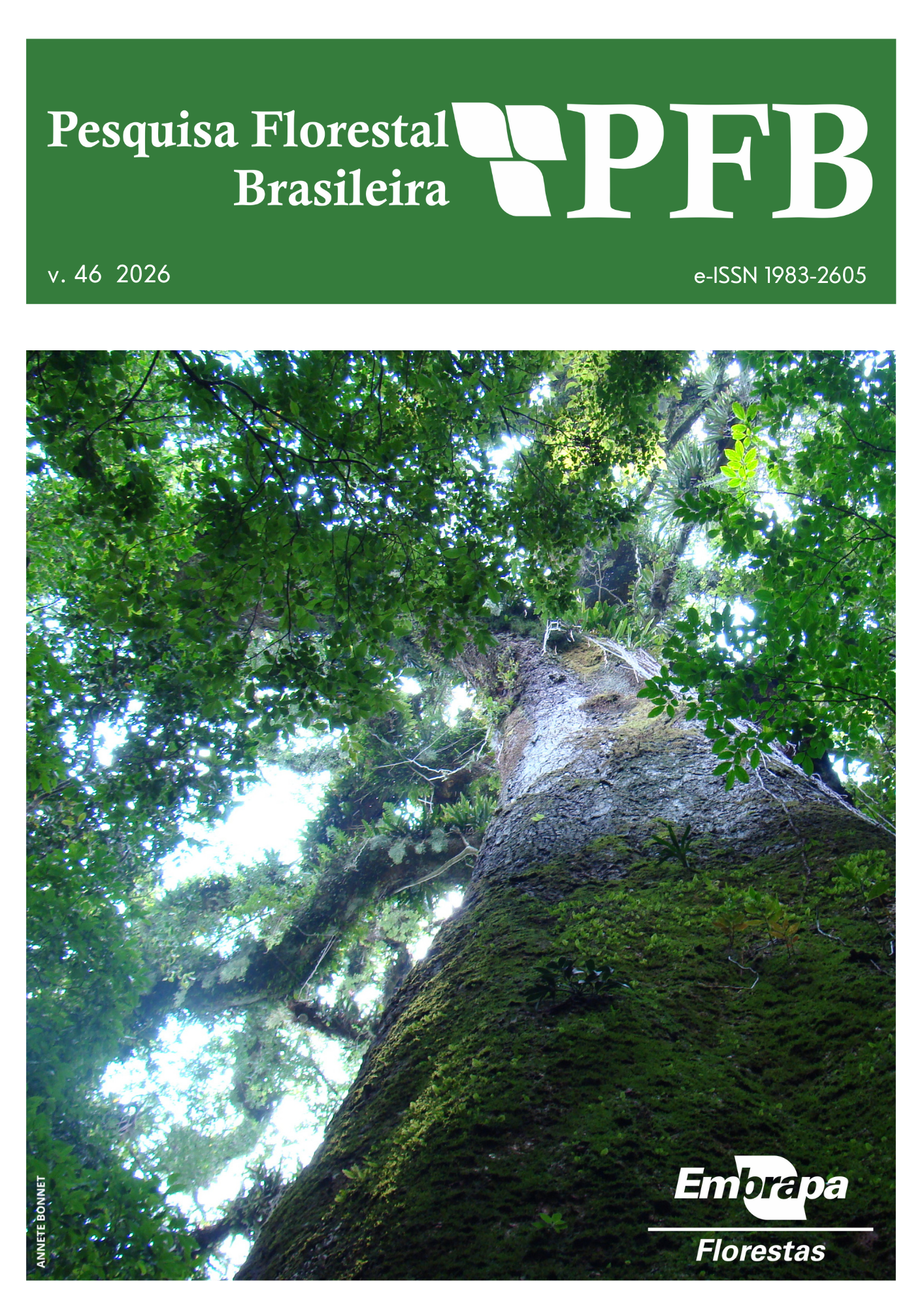
Published
How to Cite
Issue
Section
License
Copyright (c) 2026 Karine Pacheco de Jesus, Manuela Oliveira de Souza, Dráuzio Correia Gama, Tamires Santiago de Souza, Grênivel Mota da Costa, Andrea Vita Reis Mendonça

This work is licensed under a Creative Commons Attribution-NonCommercial-NoDerivatives 4.0 International License.
Pesquisa Florestal Brasileira (PFB) licenses all its published content under Creative Commons Attribution-NonCommercial-NoDerivatives 4.0 International (CC BY-NC-ND 4.0).
- Copyright: Authors maintain the copyright to their work. PFB holds the right to the first publication, and use rights under the specific Creative Commons deed.
- Editing and revision: PFB reserves the right to edit the original manuscript to ensure conformity with the standards, spelling and grammar of the Portuguese language, while respecting the style of the author(s). The final version of the text shall be sent to the corresponding author for approval prior to publication.
- Sharing and reuse: The CC BY-NC-ND 4.0 license permits sharing of the article in its original version, as long as credit is given to the journal and the authors and the material is not used for commercial purposes. No alterations or adaptations of the original content are permitted.
- Figures and illustrations: Figures and illustrations published in PFB may only be used with express prior authorization from Embrapa Forestry.
- Disclaimer: The opinions and beliefs expressed in the texts published herein are the exclusive responsibility of their respective authors and not PFB.




Funding data
-
Coordenação de Aperfeiçoamento de Pessoal de Nível Superior
Grant numbers 001





 The originals texts published in Pesquisa Florestal Brasileira are provided under